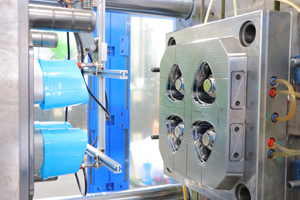
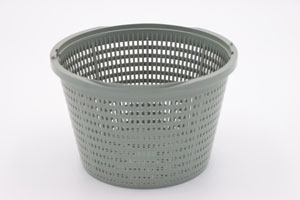
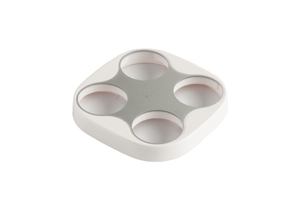
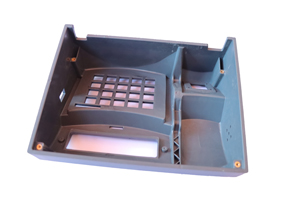
Twin-shot injection moulding is an advanced manufacturing process that enables two different materials or colors to be molded into a single finished part within one molding cycle. Compared with conventional single-shot molding or overmolding, twin-shot molding offers superior bonding quality, improved aesthetics, enhanced functionality, and higher production efficiency.
However, achieving consistent and reliable results in twin shots production requires strict control over material compatibility, process parameters, and mold design. This article provides a comprehensive overview of the key requirements and engineering considerations across these three critical areas.
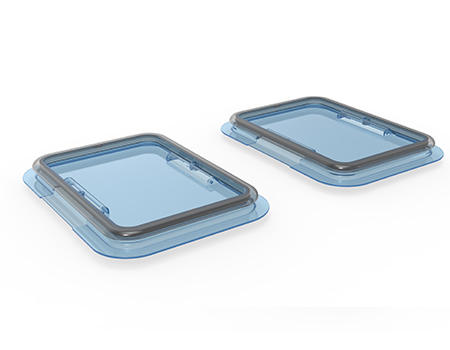
Material Requirements for Twin-shot Injection Moulding
Twin-shot injection moulding paired materials must meet two basic compatibility conditions: adhesion compatibility and process compatibility.
1. Adhesion Compatibility
Adhesion compatibility determines whether the two materials can bond effectively at the interface. Strong bonding can be achieved through:
Chemical bonding, where the polymer chains of both materials fuse during molding
Mechanical interlocking, where undercuts, grooves, or textured surfaces enhance physical bonding
| First Shot | Second Shot | Bonding Characteristics |
| PC | TPU/TPE | Excellent chemical bonding |
| ABS | TPE | Good bonding with proper grade selection |
| PC | PMMA | Moderate, structure-assisted bonding |
| PA (Nylon) | TPE | Grade-dependent, often requires mechanical locks |
| PP | TPE | Requires specially formulated TPE |
2. Process Compatibility
Process compatibility ensures that both materials can be molded under overlapping temperature, pressure, and cooling conditions without degrading or deforming each other. Key considerations include melt temperature range, thermal stability, shrinkage rate and viscosity behavior.
Excessive differences in shrinkage or thermal expansion can lead to warpage, internal stress, or delamination at the interface.
Process Requirements for Twin-shot Injection Moulding
Twin-shot injection moulding: Soft and hard rubber two-shot design
The melting points of the two materials must have a certain temperature difference, generally recommended to be 60℃, at least 30℃. The melting point temperature of the first shot material should be higher, typically the first shot is PC or PC/ABS, and the second shot is TPU or TPE. The PC should be 0.6-0.7mm thick, and the software should be over 0.4mm thick.
Try to widen the contact area, create grooves, etc., to increase the adhesive force, or use core pulling for the first shot, and inject some of the material for the second shot into the first shot. The mold surface of the first shot should be as rough as possible.
Twin-shot injection moulding: Transparent and non-transparent two-shot design
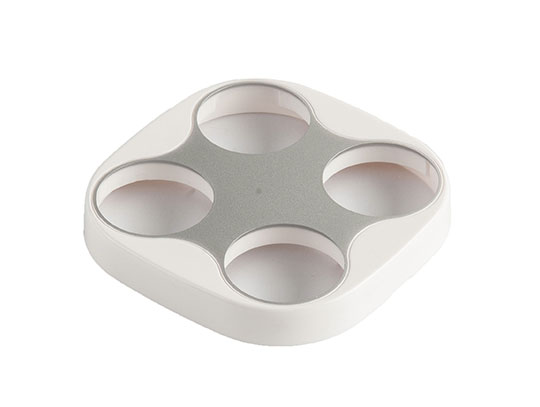
Small lens two-shot design: The first shot makes it non-transparent, and the second shot makes the lens. The first shot should use high-melting-point PC as much as possible, and the second shot uses PMMA.
Decorative transparent and non-transparent two-shot design: The first shot is non-transparent material, and the second shot is transparent material. The commonly used non-transparent material is high-temperature PC, and the second shot transparent material uses PMMA or PC. PC needs to be coated with UV protection, whereas PMMA can opt for UV or reinforcement. If there are characters on the surface, UV must be chosen.
Mold Requirements for Twin-shot Injection Moulding
The two shapes of the female mold must be different, forming one product each, and the two shapes of the male mold must be exactly the same.
After rotating the front and back molds 180° around the center, they must match.
Carefully check the maximum mold thickness, minimum mold thickness, KO hole distance, etc..
It's best if the water gate of the three-plate mold of twin-shot injection moulding can be designed to perform automatic demolding actions.
In designing the female mold of twin-shot injection moulding for the second injection, to avoid scratching the product formed during the first injection, some clearance can be designed. However, the strength of each sealing position must be carefully considered.
During injection molding, the product size from the first twin-shot injection moulding can be slightly larger so that it can be pressed tighter with another male mold during the second molding, achieving a sealing effect.
Pay attention to whether the flow of plastic during the second injection will impact the product already molded during the first injection, causing deformation of the sealing position.
Before the A and B plates of twin-shot moulding close, pay attention to whether the front mold slide or inclined top will reset first and damage the product.
The water arrangement for two female molds and male molds of twin-shot injection moulding should be as full and balanced as possible.
99% of twin-shot injection moulding involves first molding the hard rubber part of the product, then molding the soft rubber part, as soft rubber is easy to deform.
Twin-shot injection moulding is a powerful manufacturing solution that enables complex, high-performance plastic parts to be produced efficiently and reliably. However, its success depends on the synergy between material selection, process control, and mold engineering.
By carefully addressing two shot molding material compatibility, optimizing injection parameters, and designing precision molds, twin shot toolmakers can achieve superior product quality, strong interfacial bonding, and stable long-term production, unlocking the full potential of twin-shot injection moulding technology.
Read More Articles about Twin-shot Injection Molding: