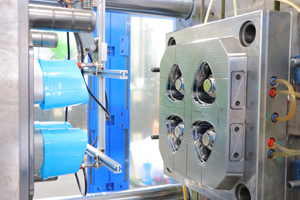
2K molding and overmolding are two common injection molding techniques. They differ in production process, application range, and material usage. Understanding the differences between the two will help in better selecting the suitable injection molding method to meet the needs of various products.
What is 2K Injection Molding?
2K injection molding, also known as two-shot molding, is an advanced manufacturing process that combines two different materials or colors into a single molded part during one production cycle. Using a specialized injection molding machine, the first material is injected into a mold, and then a second material is injected either onto, around, or alongside the first to create a fully bonded, multi-material component.
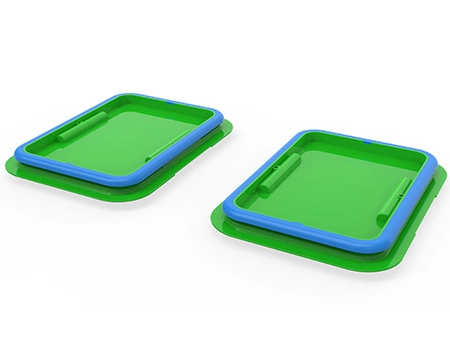
2K Molding vs Overmolding: Process Principles
2K molding technology refers to the use of two different materials, usually two different types of plastics or plastic combined with other materials, in the same mold. These two materials are injected into the mold in two or more stages, each time using a different injection molding machine or switching within the same injection machine. Each material forms different layers or components in the mold, which ultimately combine into a composite product.
In contrast, overmolding typically involves injecting another material onto an already formed substrate. First, one material (such as hard plastic) is injection molded. Then, the formed substrate is placed into a second mold, and another material (usually soft plastic or rubber) is injected to form a product with an outer covering layer.
2K Molding vs Overmolding: Application Areas
2K molding is suitable for products that require a combination of different functions or performances. For example, the combination of hard and soft plastics can make a product that possesses hardness while also providing flexibility or anti-slip effects. Common applications include automotive parts, household appliance housings, and cell phone cases.
Plastic overmolding, on the other hand, focuses more on combining two different materials to enhance the appearance, comfort, or protection of the product. Common applications include power tool handles, toothbrushes, and automotive interior trim parts. It is especially suitable for products that require comfort and aesthetics.
2K Molding vs Overmolding: Material Usage
2K molding uses two or more different types of materials. These materials can be different types of plastics or a combination of plastic and other materials. This provides great flexibility, meeting the multifunctional needs of various products.
Overmolding usually uses the same type of material but layers the materials together through different processes. For example, a layer of soft plastic over hard plastic to enhance the product's comfort or functionality. This process focuses on the combination and covering of materials rather than combining multiple functions or performances.
2K Molding vs Overmolding: Efficiency and Cost Differences
2K molding generally has lower production efficiency because it requires the use of two different materials and switching in the production process. This process has high equipment requirements, needing special injection molding machines and multiple injection steps. Thus, the cost of 2k molding is relatively high, making it suitable for high-performance, high-value-added products.
Overmolding, in comparison, is a simpler process. It only requires a second injection on an already formed substrate, thus having higher production efficiency and lower costs. It is suitable for mass production of products with low functional requirements.
| Feature | 2K Molding | Overmolding |
| Process Principle | Two different materials are injected sequentially into the same mold (often using two machines or switching within one machine) to form a composite part | A second material is injected onto an already molded substrate |
| Production Complexity | Complex process requiring precise sequencing and potentially specialized machinery | Simpler process; secondary injection is applied over an existing part |
| Material Usage | Allows two or more different materials—injection of differing plastics or plastic combined with other materials | Generally uses the same type of injection material, layering a second (often softer) material onto a base |
| Applications | Ideal for parts requiring multifunctional properties—rigidity plus softness, anti-slip features, multi-colors | Commonly used for improving ergonomics or appearance |
| Efficiency & Cost | Lower efficiency; setup is more complex and tooling cost is higher, best suited for high-value, high-performance parts | Higher efficiency and lower cost; simpler tooling makes it suitable for high-volume, less complex applications |
Both 2k molding and overmolding have their advantages. The key of overmolding vs two shot molding is to choose the appropriate process based on the product's functional requirements, appearance, and production costs. 2K molding is suitable for products that require multiple material combinations and high functional demands, while overmolding is suitable for those emphasizing comfort, appearance, and production efficiency. Understanding the differences between the two will help make more precise choices in the manufacturing process of plastic products.
Read More 2K Molding Articles:
What is the Difference Between 2K Molding and Overmolding?
Design Essentials and Development Applications of Two-Color Injection Molding